Published
How Long Should a CV Be in 2026? The Definitive Guide
One page under 10 years' experience, two pages at senior level, longer only for academia. Here's the evidence behind each rule and when to break it.

TL;DR: One page if you have under 10 years of experience, two pages for senior roles, and only academic CVs should run longer. Every weak bullet on page two dilutes the strongest one in the seven-second first scan most recruiters give you. Audit your current CV against the cut-test in section five before you add a page.
How long should a CV be? The 7-second answer
A recruiter spends roughly 7.4 seconds on the initial scan of your CV before deciding whether to read further — up from six seconds in 2012, according to Ladders' 2018 eye-tracking study. That number is contested for methodology (the sample size was never published), but every working recruiter you ask confirms the direction: the first pass is brutally short.
That single fact drives the whole page-count question. Length is not a matter of taste. It is a question of how much you can ask a stranger to process in the time it takes to read this paragraph.
The answer depends on three axes: your career stage, the type of document, and the country you're applying in. Here's the short version.
| Situation | Recommended length | Source |
|---|---|---|
| Under 10 years of experience (US/EU résumé) | 1 page | Indeed |
| 10+ years, or senior/specialist roles | 2 pages | ResumeGo 2018 study |
| UK CV (past graduate level) | 2 pages | Oxford Careers Service |
| Australian CV (mid-to-senior) | 2–3 pages | MyPerfectResume |
| Academic CV (new researcher) | 2–4 pages | Georgetown Career Center |
| Academic CV (tenured/senior) | up to 10 pages | Georgetown Career Center |
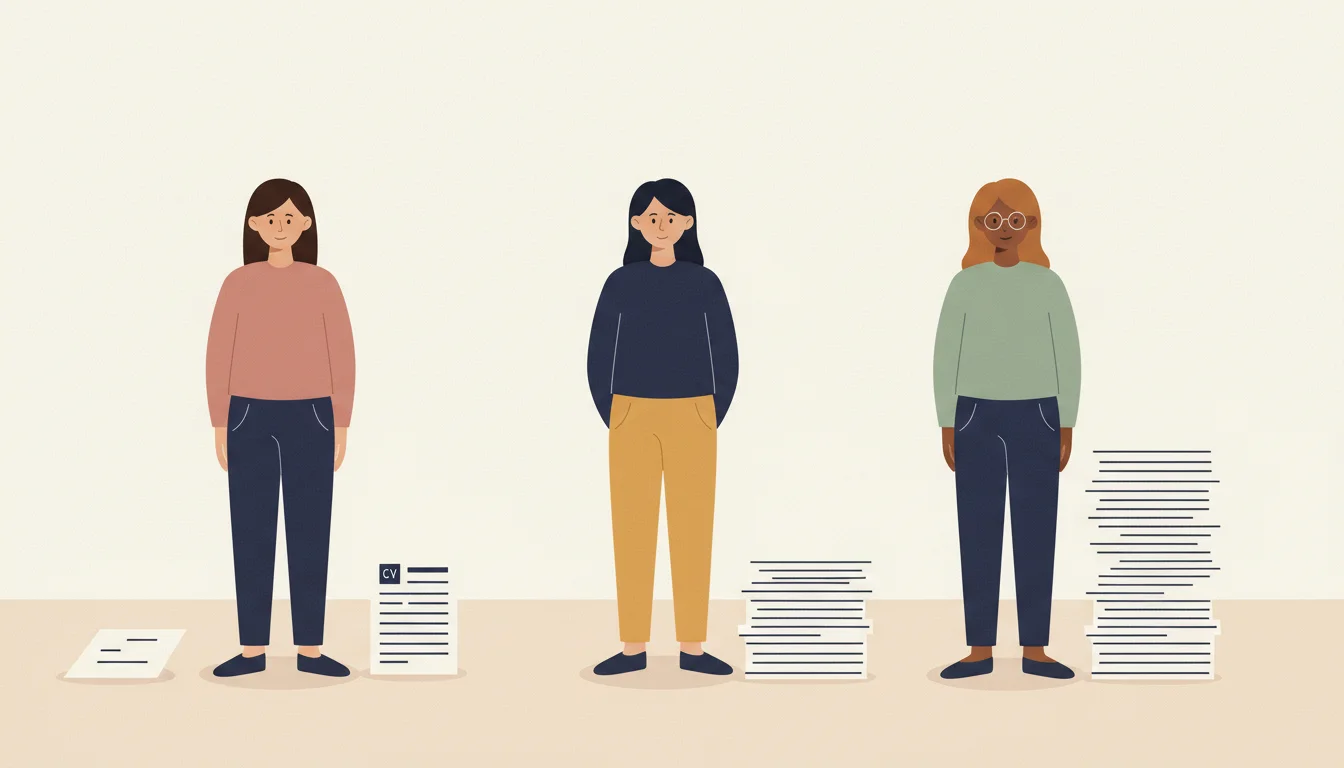
For a deeper look at which document type you actually need, the CV vs résumé difference guide breaks it down.
Why one page still wins for most jobseekers
The one-page rule is older than the seven-second scan, and it has survived for a reason: forced brevity is a quality filter.
The counter-evidence is real. ResumeGo's 2018 study asked 482 recruiters, hiring managers, and HR professionals to review matched one- and two-page résumés, and found participants were 2.3 times as likely to favour two-page résumés across the board — and 2.9 times as likely for managerial roles. That's the headline most commentators stop at.
The detail most miss: for entry-level candidates, the preference dropped to 1.4x. And the study was run by a commercial résumé-writing service that sells two-page résumés, not an independent research group. Treat it as useful directional evidence, not gospel.
The working rule is this: if you have fewer than ten years of relevant experience, one page forces you to pick your three strongest stories and cut everything else. That's a feature. A dense, well-prioritised one-page CV beats a two-page CV padded with summer internships and university societies every time. Indeed's US guidance puts it plainly: one page is the target for professionals with one to ten years of experience.
Relevant experience: paid work in your field, substantial internships (three months or longer), and professional freelance projects. A semester as club treasurer does not count. Neither does a one-week work-experience placement from school.
The cost of a second page is the one most career coaches won't name: your strongest bullet has to share the recruiter's attention with your weakest. If your best achievement is on page two, the person scanning your CV in seven seconds will never see it.
When two pages is the right call
Two pages is not an upgrade you earn for time served. It is a specific answer to a specific problem: you have too much genuinely relevant material to compress onto one page without losing evidence that changes the hiring decision.
The conditions that justify page two:
- Ten or more years of directly relevant experience. Four jobs × five accomplishments each × one line per accomplishment doesn't fit on one page without shrinking the font past readability.
- Five or more years in a technical or specialist role with publications, patents, open-source contributions, or named projects that a reviewer will actually look up.
- Senior management roles where the scope of what you ran — team size, budget, P&L, geography — needs context to be legible. "Led a team of 4" and "Led 140 engineers across three time zones with a €28M budget" both take one line. One of them needs the second line to explain the stakes.
- UK CVs past graduate level. Oxford University Careers Service recommends "a maximum of two pages, except for an academic CV," and Indeed UK takes the same line. Two pages in the UK is default, not indulgence.
One sector-level exception worth naming: Oxford Careers notes that UK investment banks often expect one-page CVs even from experienced applicants. The banking convention is stricter than the general UK norm. Check the employer before the country.
The academic and PhD CV: why longer is expected
The academic CV answers a different question: not "hire me for this job" but "here is my scholarly record." A commercial CV makes a case; an academic CV documents publications, conference talks, teaching experience, grants, and committee service against which the hiring committee measures you.
Georgetown's Career Center is explicit: "CVs are typically 2-to-4 pages for a new professional, with a recommended maximum of 10 pages for a seasoned professional." Georgetown's Graduate Career Center adds a more granular breakdown: early-stage doctoral students run 2–4 pages, advanced doctoral candidates 4–7 pages, and postdoctoral scholars or faculty applicants 6 to 10 or more.
For a PhD application specifically, 2–4 pages is the standard. The reader wants to see research experience described in detail — methods used, questions investigated, outcomes produced — not compressed to a single bullet per project. Cutting a publication to save space is the wrong trade; publications are the evaluation criterion.
Europass CVs sit in an awkward middle ground. The official EU guidance says two pages are usually enough, but the templated structure — with prompts for every language, digital skill, and training course — encourages users to fill every field. The result, as Resume.io notes, is that Europass CVs "often" run to two pages or longer, while a lean traditional CV is usually one to two pages maximum. A shorter, tailored Europass still outperforms a padded one. Fill only the sections that help the specific application.
The personal profile question deserves a direct answer here too: for any CV, the summary at the top should be 3–4 lines — roughly 50–80 words. If it runs longer, it's not a summary. The CV personal statement examples post shows what that length looks like in practice.
How to cut your CV to the right length
The editing work is almost always about cutting, not adding. Before you reach for a second page, run this procedure on the draft you have.
- 1
Cut jobs older than 15 years
Compress any role more than 15 years old to a single line (title, employer, dates) or remove it entirely if it's not relevant to the target role. The detail served its purpose when you were applying to your next role — it's dead weight now.
- 2
Delete every bullet without a measurable outcome
Rewrite each bullet to lead with a number, a named system, or a concrete result. 'Responsible for managing the customer database' becomes 'Migrated 180,000 customer records to Salesforce with zero data loss over a six-week cutover.' If a bullet can't be rewritten this way, delete it.
- 3
Kill the dead phrases
Remove 'References available on request' (everyone knows). Cut 'Dynamic, results-oriented professional' and every variation. Delete any skill list item you couldn't be interviewed on for 15 minutes.
- 4
Trim the personal profile to 3–4 lines
A summary longer than 80 words stops being read. Name your current role, your specialism, and the one outcome you most want the reader to remember.
- 5
Adjust typography before adding a page
Tighten margins to 1.5–2cm. Use a 10–11pt body font with clear section spacing. These changes buy you roughly 20% more usable space without any loss of readability.
The order matters. Start with content cuts, not formatting tricks. If you're on page two after step four and still out of space, the CV wants to be two pages. If steps one through four drop you back onto one page, the CV was padded — page two was never the right answer.
One more principle: consolidate repetition. If "Python" appears as a bullet in three different job entries, it belongs in the Skills section once, not three times.
Country differences: UK, US, Australia, and Europe
Length conventions are not universal, and advice that's correct in one country is wrong in another. The split is real and worth tracking if you're applying across borders.
| Country | Typical length | Notable convention |
|---|---|---|
| United States | 1 page under 10 years; 2 pages above | Photo-free; "résumé" not "CV" for commercial roles |
| United Kingdom | 2 pages default past graduate level | Photo-free; some sectors (banking) expect 1 page |
| Australia | 2–3 pages standard, up to 5 for executives | More tolerant of length than US/UK |
| Germany (Lebenslauf) | 1–2 pages, tabular format | Photo typically included; strict structure |
| Finland (ansioluettelo) | 1–2 pages | Photo conventional for commercial CVs; prohibited on academic research-funding CVs |
| France | 1–2 pages | Photo optional; increasingly omitted |
| Europass (EU-wide) | 2–3 pages in practice | Templated structure encourages fuller sections |
Two nuances worth naming. First, Australian sources disagree: MyPerfectResume cites "two to three pages" as average, while other Australian guides push 1–2 pages as the norm and 3 only for senior roles. The safer read for a mid-career Australian candidate is two pages, with three reserved for executive applications.
Second, the German Lebenslauf is a structural convention as much as a length one. The University of Hohenheim describes it as "a CV in a table format… divided into meaningful blocks that are clearly structured and is 1 to max. 2 DIN-A4 pages long." The tabular layout (tabellarischer Lebenslauf) is the default, and deviating from it looks more disorganised than creative.
Finland's photo convention is itself split. The University of Helsinki states that omitting a photo on a commercial ansioluettelo can make you "stand out negatively," while the Research Council of Finland explicitly prohibits photos on CVs submitted for research funding. Know which audience you're writing for.
For ATS-specific formatting concerns that apply across countries, see the ATS-friendly resume format guide.
Common length mistakes and how to fix them
Five failure modes account for most length problems on real CVs.
- The half-empty page two. Page two is 40% blank. Either cut to one page or add genuine content — pick one. A ghost page signals you didn't edit.
- The 9pt crush. A one-page CV achieved by shrinking the font to 9pt with 1cm margins is not a one-page CV. It's unreadable. Go to two pages before sacrificing readability.
- The full-degree-transcript. Listing every module from a three-year degree is a tell that you have nothing else to say. Name the degree, the institution, and the result. Skip the module list unless you're applying for your first role and a specific course is directly relevant.
- The skill-stack-per-job. Repeating "Python, SQL, AWS" in three separate job descriptions wastes lines. Consolidate into one Skills section and let the job entries describe what you did with those skills.
- The wrong-country photo. Including a headshot on a US or UK CV adds 3–4cm of vertical space for no benefit and runs against the local convention. In Germany or Finland, include it; in the UK, US, or Ireland, cut it.
How long should a CV be for a master's application?+
2 pages is standard, with more detail on research projects, relevant coursework, and any publications or conference presentations. Treat it closer to an academic CV than a commercial one.
Is a 3-page CV ever acceptable outside academia?+
Rarely. In Australia, 3 pages is within convention for senior roles. In the UK and US, a 3-page commercial CV should almost always be cut to two. The exception is if a recruiter explicitly asks for fuller detail.
Does font choice affect acceptable CV length?+
Indirectly. A readable 10–11pt font with 1.5–2cm margins sets the floor. If you need a smaller font to fit one page, you needed two pages.
Should I match my CV length to the job description length?+
No. CV length is driven by your experience and the local convention, not the length of the posting. Tailor content to the job, not page count.
If you want a structured audit of your current CV against these rules, upload it to cvmakeover.ai and get a length-and-content diagnostic in under a minute.
Key takeaways
- The real cost of a second page isn't the page itself — it's that your strongest bullet has to share recruiter attention with your weakest. If your best work ends up on page two, the seven-second scan never reaches it.
- Academic CVs are the genuine exception: 2–4 pages for a new researcher and up to 10 pages for a tenured academic, per Georgetown's guidance.
- Country conventions diverge enough to matter when applying across borders: UK defaults to two pages, US to one under 10 years, Australia tolerates 2–3 for mid-to-senior, and Germany expects a tabular Lebenslauf at 1–2 pages.
- A two-page CV with a half-empty page two is worse than a tight one-page CV — padding reads as weakness, not seniority.
- The personal profile at the top should be 3–4 lines (50–80 words), not a full paragraph. If it runs longer, it stops being read.
- Before adding a page, cut jobs older than 15 years to one line, delete every bullet without a measurable outcome, and tighten margins to 1.5–2cm. Only add page two when content forces it.